
Before I bought this thing, I did what everyone does. I read forty reviews, sorted by most helpful, and skimmed the five-star ones looking for reassurance. Almost none of them mentioned the things that actually tripped me up the first week. Not because people were lying, but because once you know a gadget's quirks, you stop noticing them. They become second nature so fast you forget they were ever confusing.
I'm Robin, and I've had the Hamilton Beach Breakfast Sandwich Maker on my counter for a while now. I already wrote a long-form review covering my day-to-day use of it, so this one is different on purpose. This is the stuff I wish someone had told me on day one, the fine print buried under the star rating, and a few opinions that might sting a little if you're already set on buying one.
The Quick Verdict
A smart little machine that's easy to underuse if you skip a few unwritten rules, and easy to resent if you buy it expecting more flexibility than it has.
Amazon Check Today's Price →Thinking about buying one? Read this first, not the star rating.
It's a genuinely good machine once you know its quirks. See today's price on Amazon and keep reading before you decide.
Amazon Check Today's Price on Amazon →How I Tested It
I didn't just cook the standard sandwich a hundred times and call it a review. I tried to break the Hamilton Beach machine on purpose. I ran it with cold ingredients straight from the fridge instead of room temperature. I forced in oversized bread just to see what would happen. I skipped steps in the manual to see what actually happens versus what the instructions warn you about. I let a friend who'd never seen the machine before try it cold, no coaching, just the box and the quick-start card, and I watched where she got confused.
That last part taught me the most. Most of what frustrates new owners isn't a flaw in the machine. It's a gap between what the box implies and what the first few uses actually feel like. This review is built around that gap.
The Twist Step Nobody Reads Carefully
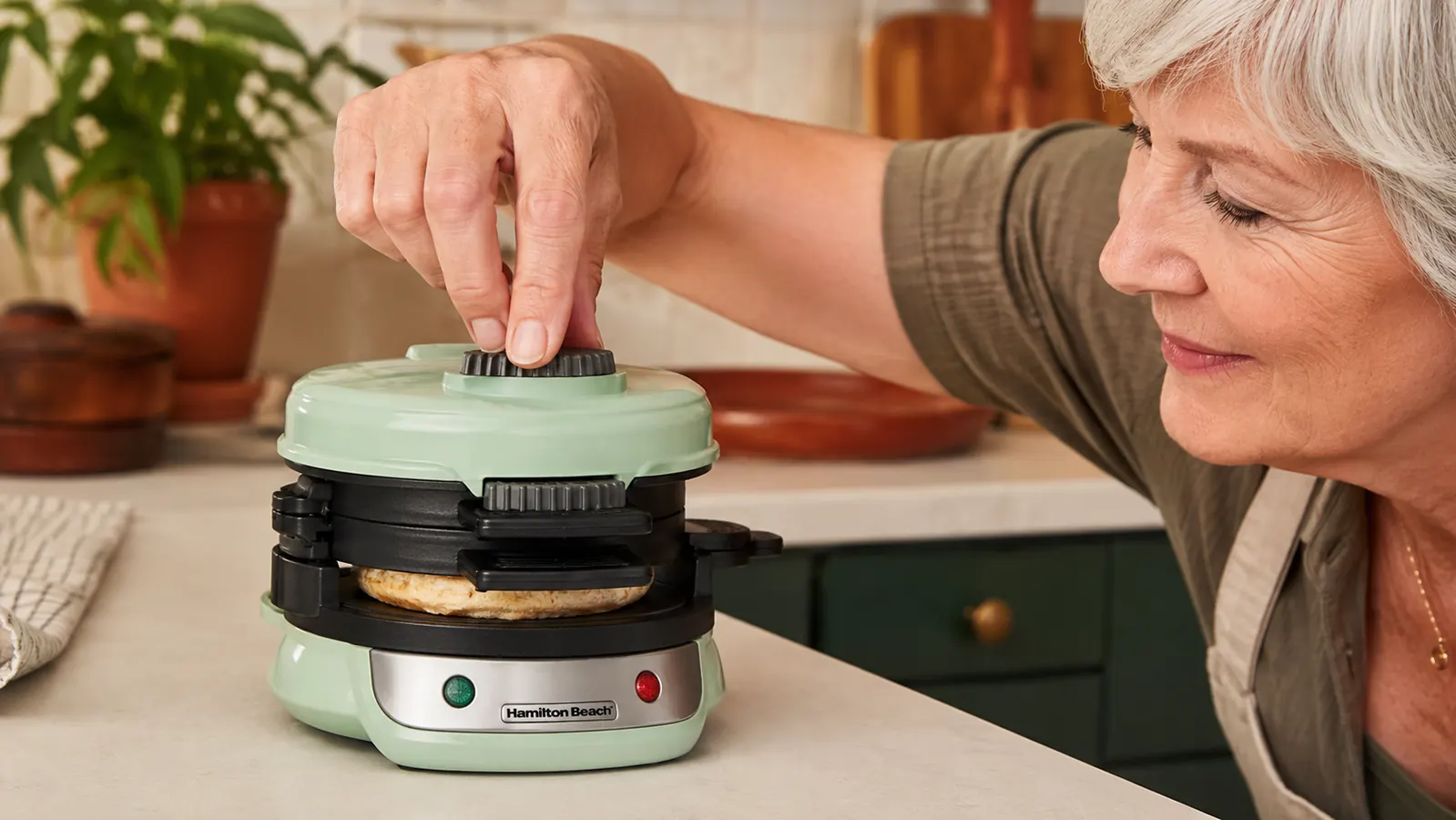
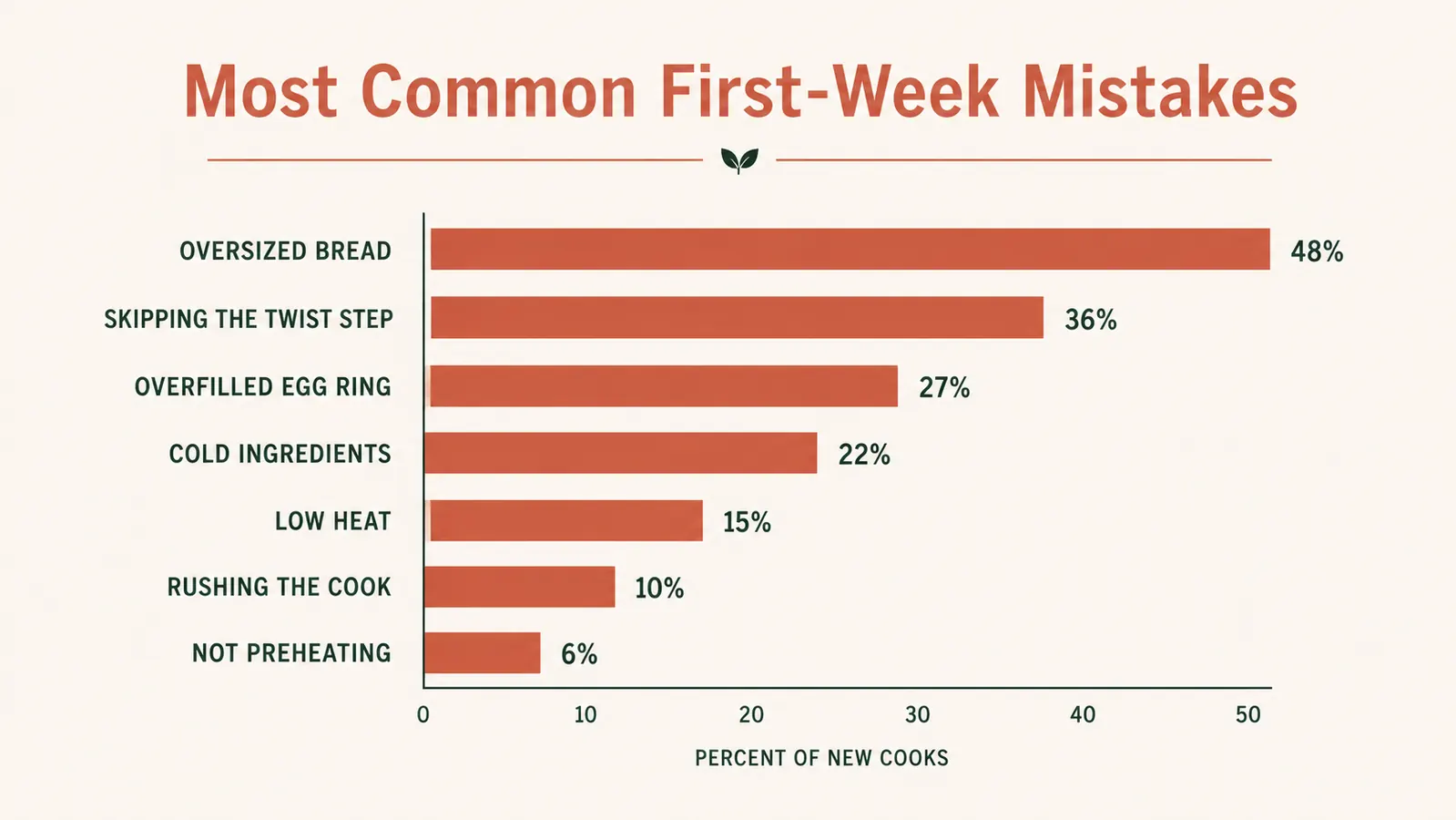
Buried in the instructions is a step where you're supposed to twist the top plate about thirty seconds into the cook cycle. It's easy to miss because it's not intuitive. Most countertop appliances are close the lid, walk away, come back. This one asks you to interact with it mid-cycle, and if you don't, the egg and the top layer don't separate cleanly when the cycle finishes.
When my friend tried it without coaching, she skipped that step entirely because she didn't see it coming. Her sandwich still cooked, but pulling it apart afterward took some coaxing with a butter knife, and a bit of egg stayed stuck to the underside of the top plate. It wasn't ruined, just messier than it needed to be. If nobody tells you about the twist, you'll figure it out eventually through trial and error, but there's no reason to burn a sandwich's worth of goodwill on something that takes five seconds once you know it's coming.
It's Pickier About Bread Than the Marketing Photos Suggest
The box shows English muffins, croissants, and biscuits all working interchangeably, and technically they all fit. What the photos don't show is how narrow that fit actually is. I picked up a bag of bakery bagels one week, the kind that run noticeably larger than a standard grocery-store bagel, and the lid wouldn't close flush. I forced it anyway, because I'm stubborn, and ended up with egg squeezed out around the seam and a faint burnt smell where it leaked onto the base plate.
Croissants are the trickiest of the officially supported options. A flaky, puffy croissant compresses down fine, but if it's even slightly stale it can crumble under the closing pressure instead of flattening evenly. English muffins and standard dinner rolls are the forgiving choice, and honestly, after some experimenting, they're what I'd recommend to anyone buying this for the first time. Save the croissant experiments for once you've got a feel for how much the machine can actually compress.
The Egg Ring Has an Opinion About Egg Size
This one surprised me more than it should have. The egg ring is sized for a large egg, not extra-large and not jumbo, and the difference matters more than a few grams of egg white would suggest. A jumbo egg overflows the ring slightly during cooking, and that overflow cooks into a thin, tough skirt around the outside of the patty that you either have to trim off or eat as an odd chewy ring. It's not dangerous, it's just not what you're expecting when you picture a clean, round patty.
Nobody puts egg size on the box. I only figured it out because I buy whatever carton is cheapest that week, and one week it happened to be jumbo. If you're a large-egg household already, this is a non-issue. If your fridge is stocked with jumbo or extra-large because that's what was on sale, it's worth switching down a size specifically for this machine, or just accepting the trimmed skirt as part of the routine.
Cold Ingredients Slow It Down More Than You'd Think
The stated cook time assumes you're working with ingredients close to room temperature, or at least not fresh out of a cold fridge. I ran a test morning where I used a cheese slice and a sausage patty straight from the refrigerator, no staging, no warming, just cracked the egg and stacked everything cold. The center of the sandwich came out noticeably cooler than usual, and the cheese hadn't fully melted by the time the timer would normally say it's done. I had to run it almost a full extra minute past what I usually do.
This isn't a defect. It's just physics that the instructions gloss over. If you're someone who likes to pull ingredients straight from the fridge with zero prep, budget an extra minute or two, or expect a slightly undermelted result. It's a small thing, but it's exactly the kind of detail that makes a new owner think the machine is inconsistent when really it's just responding to a colder starting point.
The Return Policy Detail That Almost Bit Me
I nearly sent mine back in the first week, and not because of anything wrong with the machine itself. I'd assumed, wrongly, that the included recipe booklet meant I needed exact ingredients to get a decent result. My first attempt used a hamburger bun I had on hand instead of an English muffin, and it came out lopsided and undercooked in the middle. I was two days from the return window closing and genuinely considering boxing the Hamilton Beach unit back up and calling it a bad purchase.
What actually saved it was switching to the ingredients the machine is built around instead of blaming the machine for my substitutions. The second I used an actual English muffin and a properly sized egg, the difference was night and day. I mention this because return windows are short, usually thirty days, and a rough first attempt with the wrong ingredients can feel like a defective unit when it's really just a mismatch between what you grabbed from the pantry and what the machine expects. Give it a fair try with the intended ingredients before you decide it's not for you.
Storage Isn't as Simple as 'It's Small'
Every listing and every review mentions how compact this is, and footprint-wise, that's true. What gets left out is that the cord doesn't tuck away anywhere, and the shape isn't especially stackable if you're storing it in a cabinet rather than leaving it out. I tried keeping mine in a lower cabinet for the first couple of weeks, thinking I'd only pull it out on weekday mornings, and the cord kept tangling with a nearby toaster cord every time I reached in.
I eventually gave up and just left it out permanently on the counter, which solved the tangling problem entirely but does mean committing real counter space to it full time, not just borrowing space for five minutes a day. If your counter is already tight, factor in that this is more of a leave-it-out appliance than a tuck-it-away one, even though the box makes it look like something you'd store between uses.
The Smell It Leaves Behind
Nobody mentions this one, and it's minor, but it's real. The first several uses, mine had a faint plastic-adjacent smell during the cook cycle, the kind of new-appliance smell you get from a lot of small electronics when the heating element first breaks in. It faded by around the second week and I haven't noticed it since, but if you're sensitive to that kind of thing, don't panic on day one. Crack a window for the first few uses and it resolves itself.

Where the Five-Star Reviews Oversell It
A lot of the glowing reviews describe this as basically replacing a fast-food breakfast sandwich outright, texture and all. I think that's a slight overstatement for what the Hamilton Beach design is actually built to do. What comes out of this machine is closer to a well-made homemade version than a fast-food clone. The egg has a firmer, more uniform texture than a griddled fast-food patty, closer to a steamed egg than a fried one. The muffin gets warm and slightly toasted from contact heat, not the crisp, buttered griddle-toast you'd get at a drive-thru.
That's not a knock. I actually prefer the texture this machine produces once I stopped comparing it to a specific memory of a fast-food sandwich and started judging it as its own thing. But if you're buying this specifically chasing that exact fast-food flavor and texture, temper your expectations a little. It's a genuinely good breakfast sandwich. It is not a chain-restaurant clone machine, and reviews that promise otherwise are setting people up to feel let down over something that was never really the product's job.
I'd also push back gently on the reviews that call the noise level a non-issue. It's not loud in any objective sense, no more than a toaster clicking, but there's a faint hum from the heating element the whole time it's running that a few reviews describe as silent. It isn't silent. It's quiet. That distinction won't matter to most people, but if you're someone who notices small appliance sounds in an otherwise quiet kitchen, know that it's there, even if it's never bothered me enough to think twice about it after the first week.
What I Liked
- Once you learn the twist step, cleanup and separation become effortless
- Consistent, restaurant-shaped egg patty every time with large eggs
- Genuinely fast once ingredients are at room temperature or prepped
- Small enough footprint to leave permanently on a small counter
- Handles a wide range of proteins as long as they're precooked
Where It Falls Short
- Missing the twist step leads to a messier, harder separation
- Picky about bread size, oversized bagels or stale croissants don't seal well
- Jumbo or extra-large eggs overflow the ring and leave a tough skirt
- Cold ingredients from the fridge slow the cycle down more than expected
- Texture is closer to a steamed egg than a fast-food griddled patty
The star rating tells you people like it. It doesn't tell you the five small things you'll figure out the hard way if nobody warns you first.
The Question I Get Asked Most: Is It Worth Learning the Quirks?
Every quirk I've listed here is a one-time lesson, not an ongoing annoyance. You learn the twist step once and it becomes muscle memory. You figure out your bread and egg size once and you just buy accordingly from then on. None of these are things that nag at you use after use, the way a genuinely poorly designed appliance would. They're more like a short onboarding period that the marketing doesn't prepare you for.
Compare that to appliances I've owned that never stopped being annoying, a blender with a lid that never sealed right no matter how I positioned it, a toaster that ran hot on one side for its entire life. This isn't that. The learning curve here is real but short, probably four or five uses, and then it disappears completely. That distinction matters more than it sounds like it should when you're deciding whether a quirky first week is a dealbreaker or just a minor toll for a machine you'll use for years.
Who This Is For
This is for someone willing to spend a handful of mornings figuring out a small machine's specific habits in exchange for years of a five-minute breakfast afterward. It's for people who don't mind that homemade means slightly different from fast food, not worse, just different. And it's for anyone buying based on a realistic picture rather than the most flattering five-star review they could find.
Who Should Skip It
Skip it if you want zero learning curve on day one, this isn't a pour-and-press machine, it rewards a little patience upfront. Skip it if you're chasing an exact fast-food replica rather than a genuinely good homemade sandwich with its own texture. And skip it if you already know you won't adjust your egg size or bread choice to match what the machine actually wants, because forcing the wrong ingredients in is where most of the frustration in the reviews actually comes from.
Now that you know the quirks, the rest is easy.
Learn the twist step and the bread size once, and this becomes a five-minute breakfast for years. Check today's price on Amazon.
Amazon Check Today's Price on Amazon →