

I bought the Hamilton Beach Breakfast Sandwich Maker last spring because I was tired of my own excuses. Most mornings I'd tell myself I didn't have time to cook, then spend twelve dollars and twenty minutes in a drive-thru line getting a sandwich that was lukewarm by the time I got home. That's not a complaint about fast food. It's a complaint about my own routine. A year later, this little machine sits on my counter every single day, and I've made a sandwich in it more mornings than not.
I'm Robin. I downsized from a house with a full kitchen to a condo with about nine feet of counter space, so anything that earns a permanent spot has to actually pull its weight. This one has. Here's what a full year of real use looks like, not a first-week impression.
The Quick Verdict
A genuinely useful five-minute breakfast machine that's held up to daily use, with a few real quirks around egg texture and the tight stacking order you have to learn.
Amazon Check Today's Price →Still driving somewhere for breakfast every morning?
This little machine layers your egg, meat, and cheese and cooks the whole sandwich in about five minutes, right on your counter. Check today's price and see if it's in stock.
Amazon Check Today's Price on Amazon →How I've Used the Hamilton Beach Machine
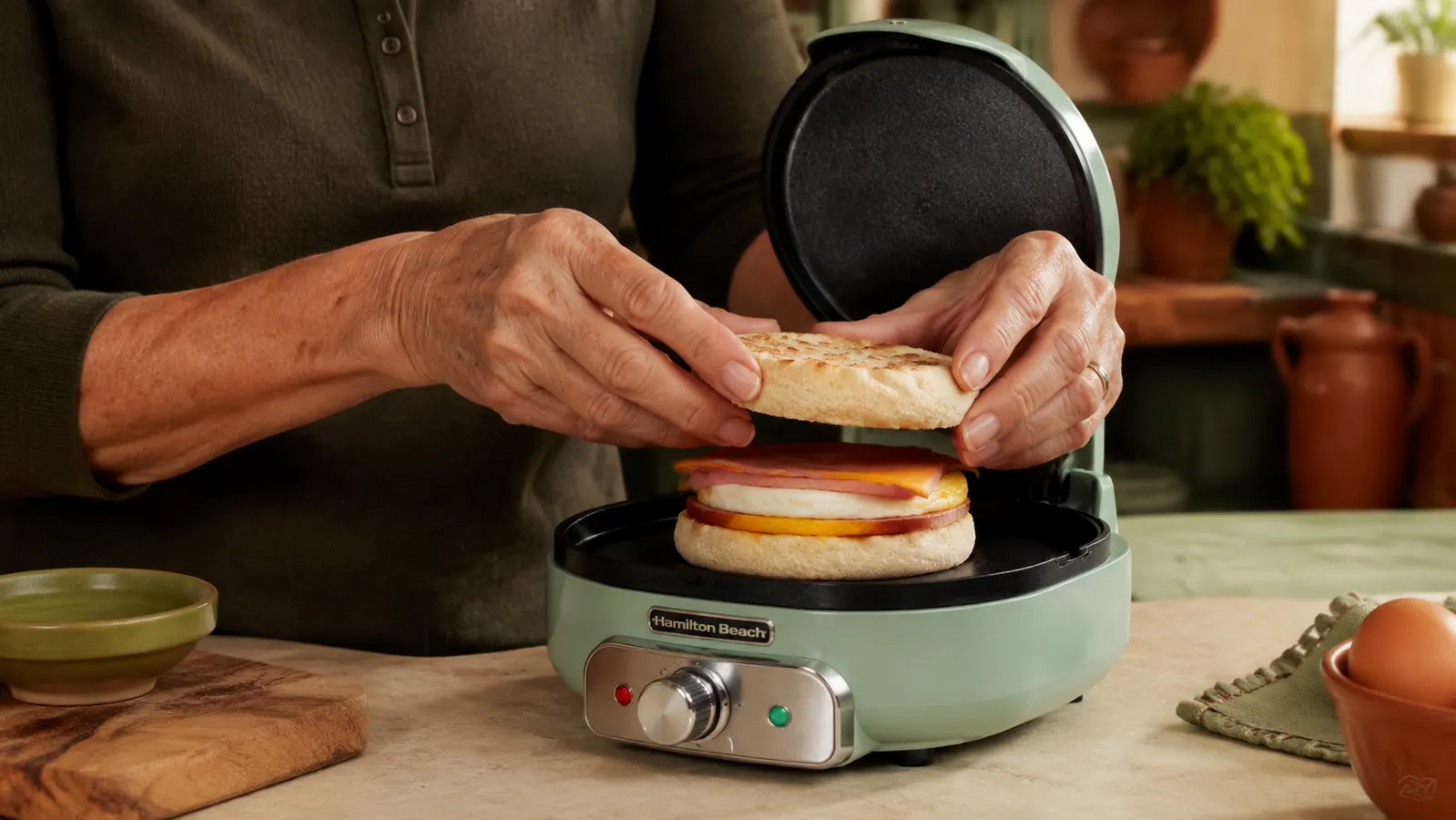
My routine is boring in the best way. English muffin bottom in first, then the egg ring filled with a cracked egg (sometimes just the white, sometimes whole, depending on my mood and my cholesterol numbers), a slice of cheese, a round of Canadian bacon or a turkey sausage patty, then the muffin top. Close the lid, twist the top plate about thirty seconds in like the manual says, wait roughly five minutes, and pull the whole stack out by the handle. It comes apart as one cooked sandwich, not a pile of parts.
I use it four to five mornings a week. Weekends I'll cook a proper breakfast on the stove because I have the time, but weekdays this is the whole show. Over a year that's somewhere around 220 sandwiches, and the machine still cooks the egg evenly and the muffin still comes out with a light toast on it, which tells me the heating plates haven't degraded the way cheap nonstick sometimes does. I've rotated through Canadian bacon, turkey sausage patties, real pork sausage on weeks I'm not watching my sodium as closely, and plain cheese-and-egg on mornings I just want something simple. The machine doesn't care what protein you use as long as it's already cooked and roughly the right diameter, which is part of why it's stayed in rotation instead of getting shoved in a cabinet after the novelty wore off.
The one habit I had to build was prepping the night before. Precooked sausage patties or bacon in the fridge, cheese slices pulled out, muffins split and ready on the counter. When everything's staged, I'm eating in under six minutes from the moment I walk into the kitchen. When I try to do it all cold, cracking the egg and hunting for cheese at the same time, it's closer to ten, and that's when I understand why people give up on gadgets like this after a week. Preparation is the whole trick.
The Egg Ring and Getting the Timing Right
The removable egg ring is the part that decides whether this machine is worth owning. It sits in the lower plate, you crack an egg into it, and it cooks into a perfectly round patty that matches the muffin. It's genuinely clever and it's the reason the sandwiches look and eat like something from a restaurant instead of a scramble stuffed between bread.
It took me about two weeks to stop overcooking the egg. The instructions say roughly five minutes total, but my particular outlet and my particular egg size meant I was landing closer to a fully firm, slightly rubbery yolk every time. I backed off to four and a half minutes and started checking at the four-minute mark on mornings I wanted a softer center. That's a small annoyance, but it's a real one. If you like a runny or jammy yolk, plan on some trial mornings before you get it dialed in, and know that a firm yolk is the default outcome, not a mistake you made.
The middle plate that separates the egg from the muffin top while everything cooks does its job well. I haven't had yolk leak down into the muffin in a year of use, which surprised me given how thin that plate looks. The only time I've had a genuine mess was the one morning I tried to squeeze in a jumbo egg instead of my usual large. It overflowed the ring slightly and left a thin cooked ring around the outside that I had to trim off with a butter knife before eating. Not a big deal, just a reminder to stick with large eggs, which is what the ring is actually sized for.
Cleanup After 200-Plus Sandwiches
This is where the machine earned real trust from me. The egg ring, the middle cooking plate, and the top lid piece all lift out and are dishwasher safe on the top rack. I hand wash mine most days because it's faster than loading the dishwasher for three small pieces, and a quick wipe with a soapy sponge takes maybe ninety seconds.
The nonstick coating has held up better than I expected for a $25 appliance. There's a little discoloration on the egg ring after a year, the kind of light staining you'd see on any nonstick pan that sees daily heat, but nothing is flaking and nothing sticks. I don't use cooking spray most mornings and eggs still release clean. On the rare morning I forget and let cheese ooze past the muffin edge, it wipes off the base plate without a fight because that part doesn't heat as aggressively as the two cooking plates. I did have one morning early on where I let melted cheese sit and harden overnight instead of wiping it right away, and that took a slightly longer soak to loosen. Lesson learned: wipe it down while it's still warm and cleanup stays under two minutes every time.
The base unit itself, the part with the cord and the heating element, never touches food and just needs an occasional wipe-down. Nothing about the cleanup routine has changed from week one to month twelve.
Who I've Recommended It To (and Why)
I've told three different neighbors to buy this thing, and their situations tell you a lot about who it's actually for. One is a single guy in his thirties who works early shifts and used to skip breakfast entirely. He uses it almost identically to how I do, prepped the night before, five minutes, out the door. Another is a widow in my building who lives alone and just wanted to stop making a whole pan and skillet dirty for one egg and one muffin. The portion size and the single-sandwich cook cycle fit her exactly.
The third is a mom with two teenagers who wanted something the kids could operate themselves without supervision. That one's worked out well too. The machine only really has one way to use it wrong, which is overfilling the egg ring, and even that just means a slightly messy edge rather than anything dangerous. All three of them asked me the same question before buying, whether a Hamilton Beach appliance this small would actually hold up, and a year of daily use later, I've stopped hedging on that answer.
If your mornings involve cooking for four or more people at once, this isn't the tool. It makes one sandwich per cycle, full stop. I'll get to alternatives in a minute, but for a household of one or two, or for someone who eats breakfast on a staggered schedule from the rest of the family, it fits naturally.
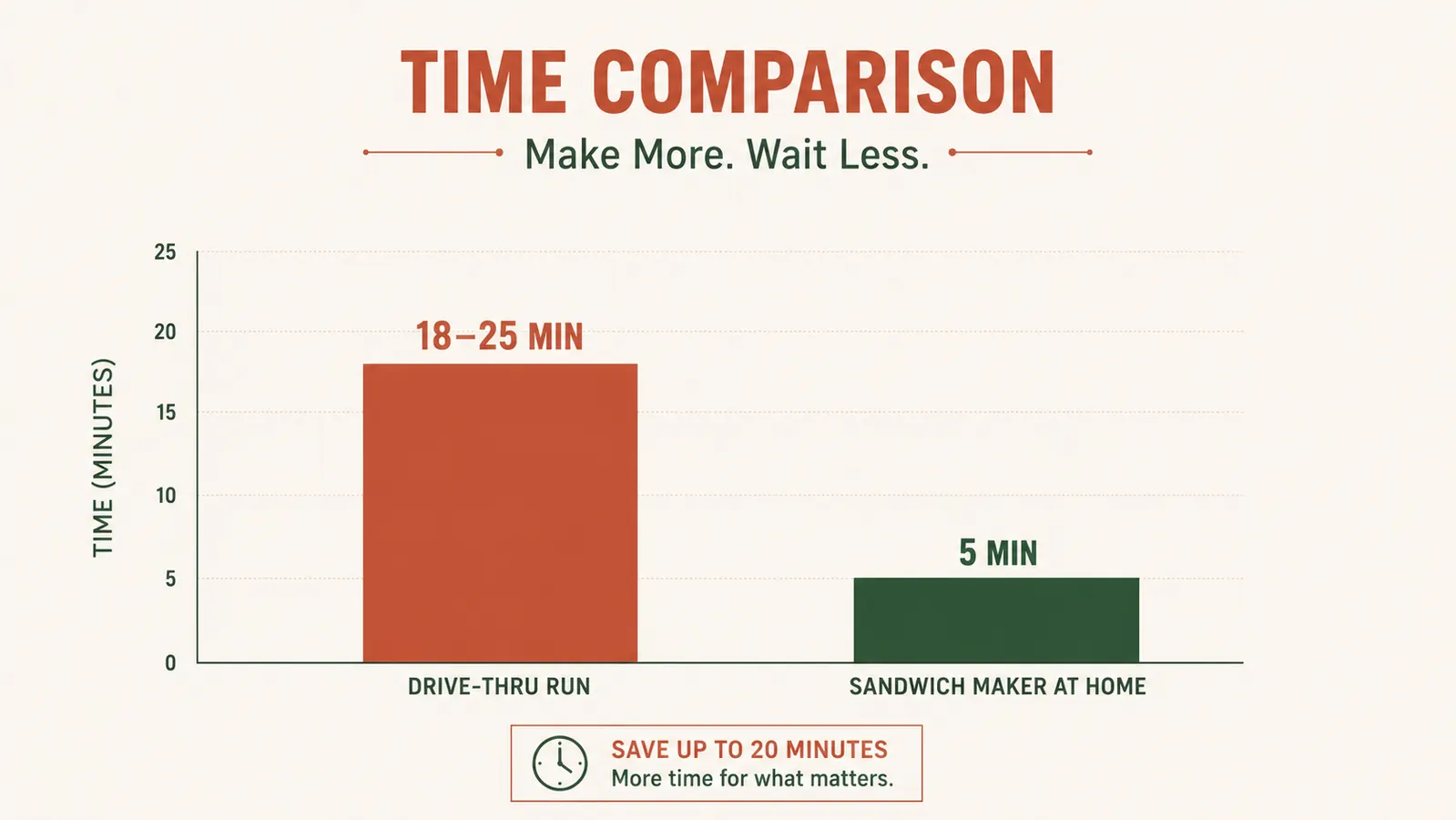
One more thing worth mentioning on the money side, since that's really what got me to buy it in the first place. A drive-thru breakfast sandwich near me runs somewhere between five and seven dollars once you add a coffee. Making the same sandwich at home with an English muffin, an egg, a slice of cheese, and a round of Canadian bacon costs me closer to a dollar twenty, generously. Even accounting for the appliance itself, it paid for its own price in under two weeks of weekday use, and everything since then has just been savings stacked on top of five minutes saved.
Where It Falls Short
I want to be straight about the tradeoffs because I don't think a review that's all praise is useful to anyone. The biggest one is that it only makes one sandwich at a time. If I'm making breakfast for myself and my sister when she visits, I'm running it twice, back to back, which stretches what should be a five-minute breakfast into closer to twelve. That's still faster than a drive-thru run, but it's worth knowing going in.
Second, the muffin size window is narrower than I expected. Standard English muffins and small dinner rolls work great. A thicker bakery bagel or a home-baked biscuit that runs even slightly oversized won't close the lid properly, and I learned that the hard way with a bagel that left egg squeezed out around the edges. Stick close to what the machine was designed for and you're fine.
Third, and this is a small thing but it bugged me for the first month, there's no timer or auto shutoff. It's on a five-minute mental countdown you have to track yourself, whether that's a phone timer or just habit. After a year I don't think about it anymore, but a new owner should set a timer the first dozen times rather than guessing.
What I Liked
- Cooks a full sandwich, egg included, in about 5 minutes
- Egg ring produces a clean, restaurant-shaped patty every time
- All food-contact pieces are removable and dishwasher safe
- Nonstick coating has held up through a year of near-daily use
- Compact footprint that doesn't crowd a small counter
- Simple enough that kids or a first-time cook can run it solo
Where It Falls Short
- Makes only one sandwich per cycle, no batch cooking
- No built-in timer or auto shutoff
- Egg defaults to fully firm, takes practice to get a softer yolk
- Only fits standard-size muffins, rolls, or bread, not oversized bakery items
It's not a fancy machine. It's a machine that does one boring, useful thing every single weekday morning without asking anything extra of me.
How It Compares to Just Using a Pan
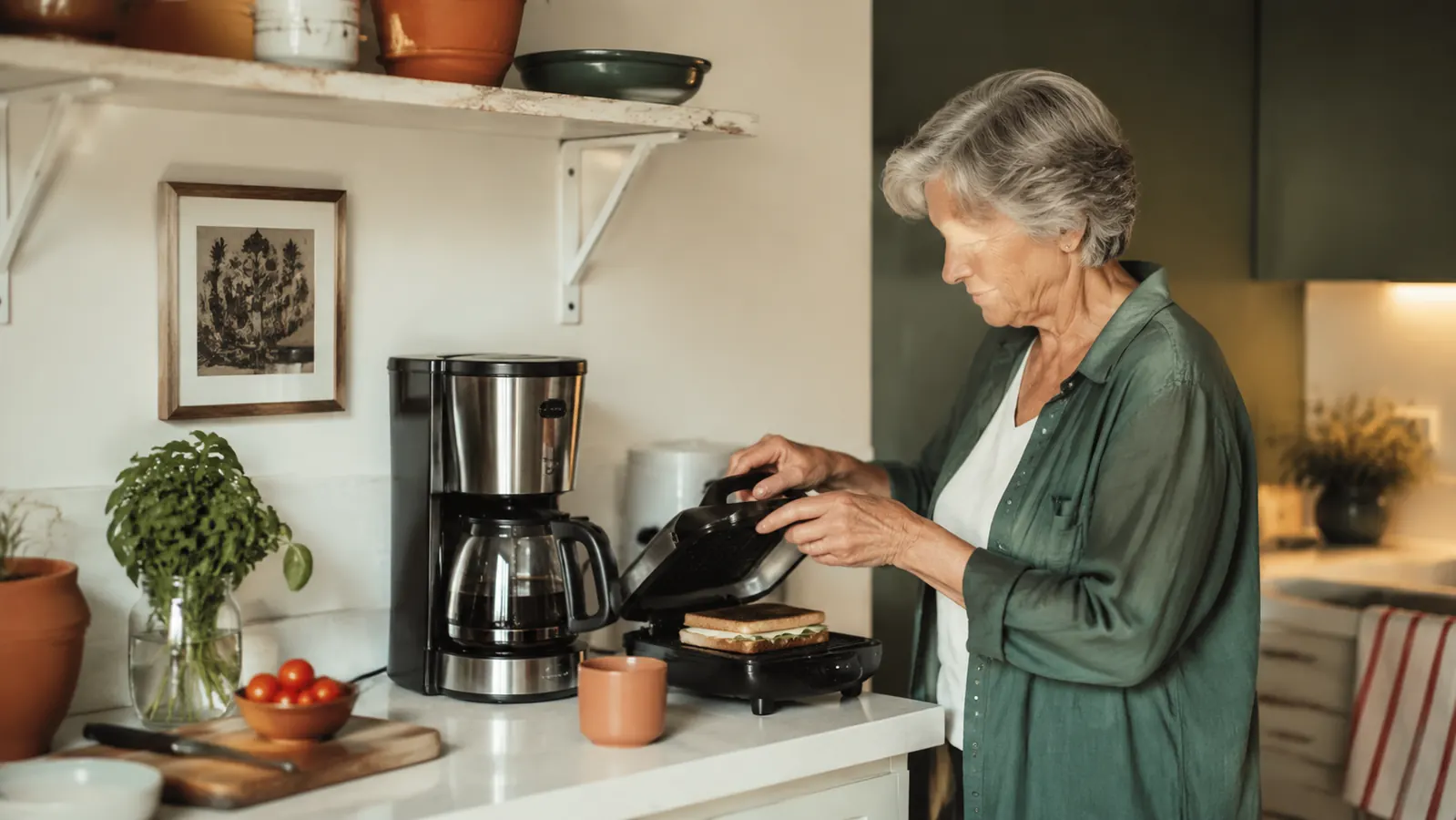
Before this, my weekday breakfast was either skip it entirely or scramble an egg in a small skillet while toasting a muffin separately, then assembling everything and washing a pan, a spatula, and a cutting board. That's a solid ten to fifteen minutes of active work and dishes, which is exactly the kind of morning task that gets abandoned first when you're rushed. The sandwich maker collapses that into one vessel and one cook cycle. The tradeoff is versatility. A skillet can make anything. This machine makes one specific style of sandwich extremely well and nothing else.
I also tried, briefly, going back to my toaster oven for a couple weeks last fall just to see if I'd notice a difference. I did. Toasting the muffin, cooking the egg in a separate ramekin, and timing them to finish together took roughly twice as long and dirtied twice as many dishes, a ramekin, a spatula, and the toaster oven tray, on top of the muffin plate. I went back to the Hamilton Beach machine within the week. The toaster oven is still a fine tool for actual toast, reheating leftovers, or roasting a small batch of vegetables, but for the narrow job of building one breakfast sandwich fast, a dedicated single-purpose machine beat a more flexible one every time.
Who This Is For
This is for someone cooking breakfast for one or two people on a weekday schedule where five minutes matters. It's for anyone who's downsized their kitchen and wants appliances that do one job reliably instead of six jobs adequately. It's for a household with a family member who eats on a different schedule than everyone else. And honestly, it's for anyone who's spent more money than they'd like to admit on drive-thru breakfast sandwiches out of pure morning inertia.
Who Should Skip It
Skip it if you're regularly cooking breakfast for a full family at once, you'll be running the cycle too many times to make sense. Skip it if you love a soft, runny egg and don't want to spend a couple weeks dialing in your own timing. And skip it if you're the type who won't prep ingredients the night before, because this machine's whole advantage disappears if you're chopping and cracking eggs cold every morning with nothing staged.
A year in, this is still the first thing I plug in every morning.
If your weekday breakfast is either skipped entirely or a slow drive-thru detour, this is worth the counter space. See today's price on Amazon before deciding.
Amazon Check Today's Price on Amazon →