
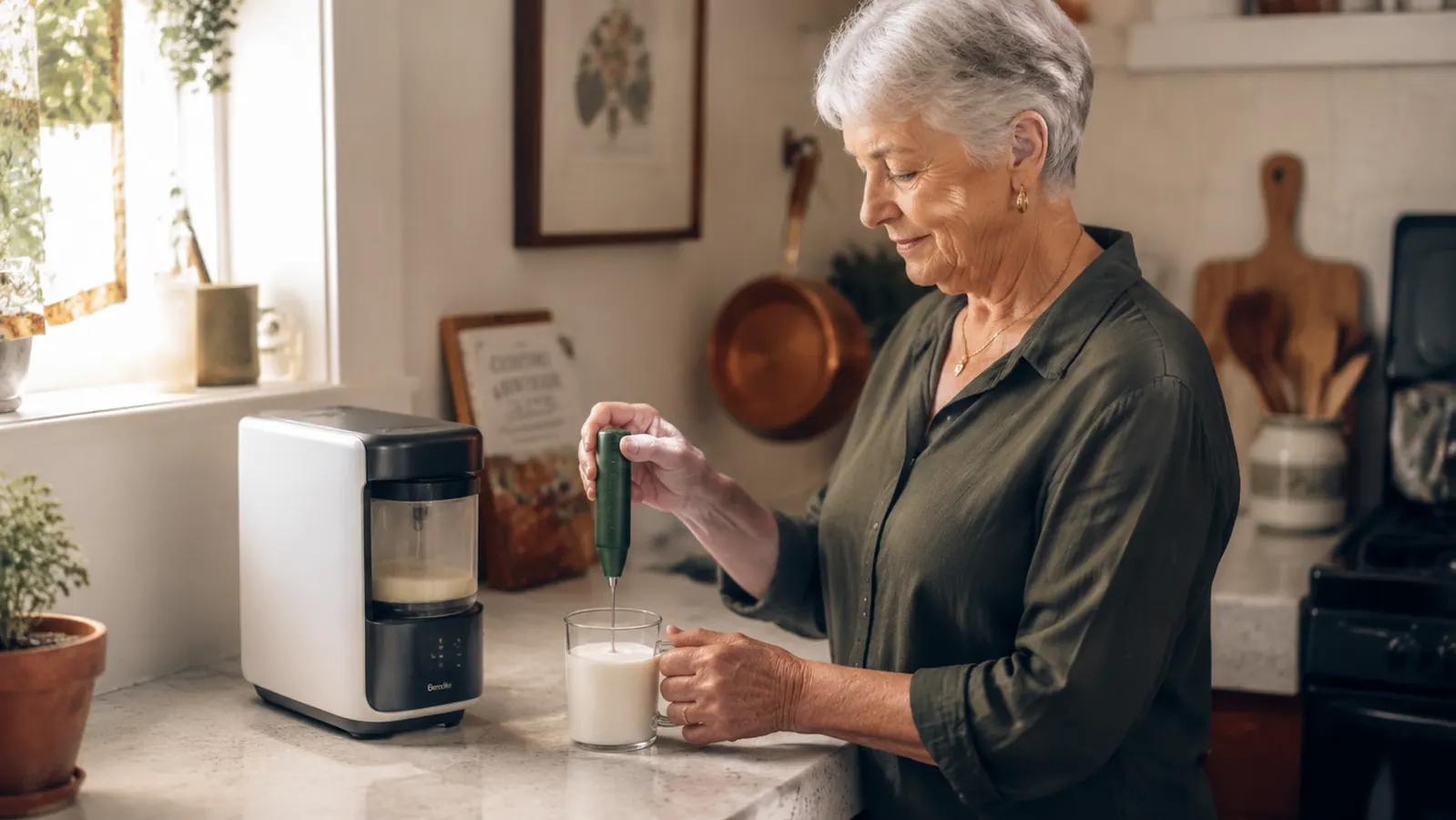
Short answer, because I know some of you just want it: if your counter is small, get the handheld frother. I've used both a Zulay handheld wand and a standalone electric frothing machine in my own kitchen, and only one of them is still out where I can reach it every morning.
The standalone machine makes a nicer, more consistent foam if you're doing it for company. But most mornings it's just me and a cup of coffee, and the wand wins on nearly everything that matters day to day: space, price, and how fast I can put it away when I'm done. Let me walk through how I actually landed there, because it took me longer than it should have to admit the fancier machine wasn't the right fit for how I actually live now.
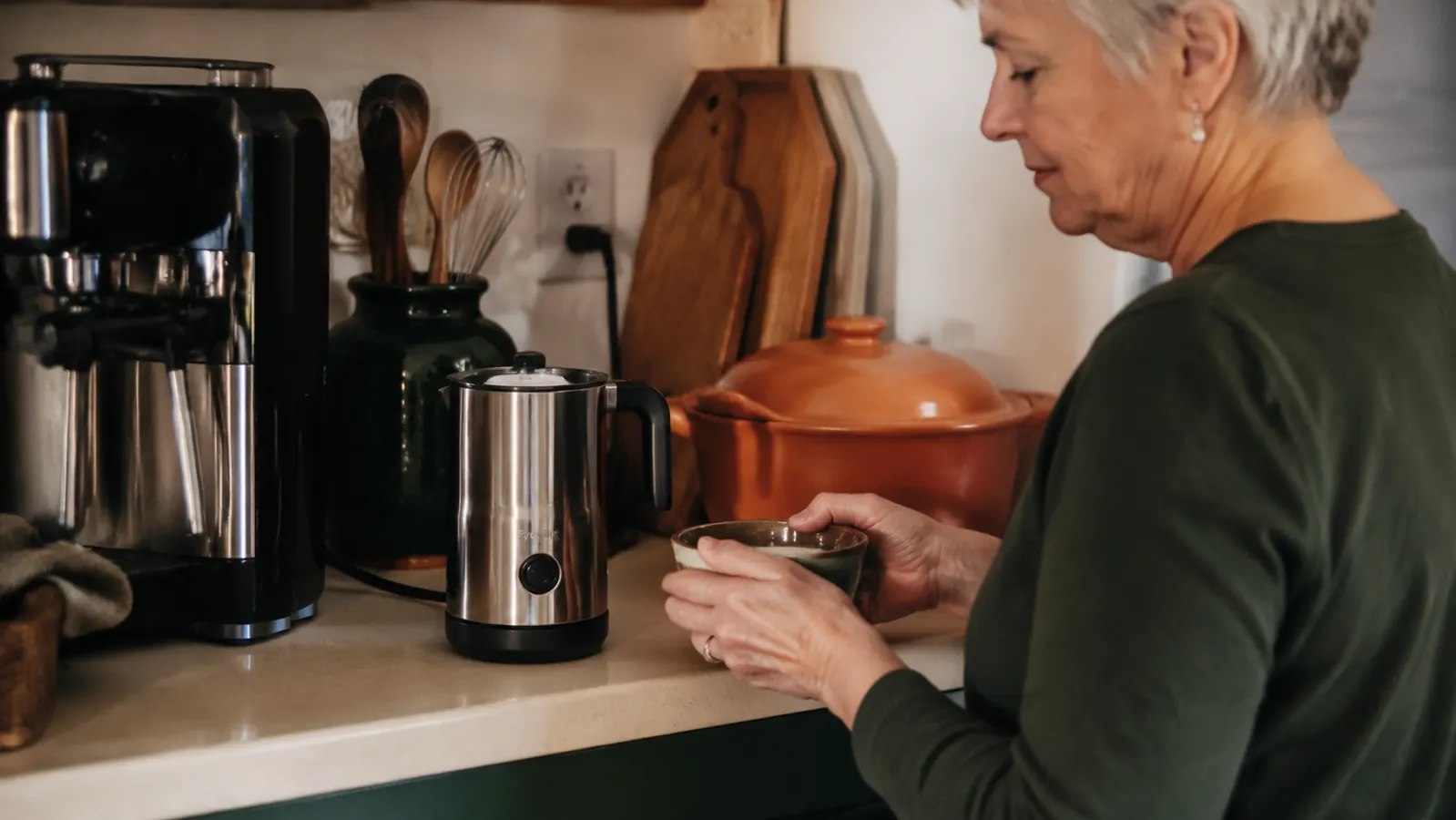
When I moved out of my old house and into this apartment, I brought a standalone frother with me. It was a gift from my daughter a few Christmases back, a nice one, stainless steel, the kind that heats and whisks in one pitcher. In the old kitchen it had a permanent spot on the counter next to the coffee maker and I barely thought about it. In this kitchen, with about a third of the counter space, it became a problem before I even unpacked the second box.
I tried to make it work for the first month. I'd shuffle it from the counter to a cabinet shelf and back, which sounds simple until you're doing it every single morning before you've had coffee. My husband started calling it the shuffle, as in, are you doing the frother shuffle again. That's usually a sign an appliance isn't earning its keep. So I picked up the Zulay wand mostly out of curiosity, thinking it would be a downgrade I'd tolerate. It wasn't, and that surprised me more than it probably should have.
| Zulay Handheld Frother | a Standalone Electric Frother | |
|---|---|---|
| Product | Zulay Handheld Milk Frother | Standalone Electric Frother (pitcher-style) |
| Price | Under $10 at today's price | $35 to $60 typically |
| Counter footprint | None, fits in a drawer | About 5 in. wide base, stays out on the counter |
| Power source | 2 AA batteries | Plugs into an outlet, needs its own dedicated space |
| Capacity per use | Whatever fits in your mug, usually 4 to 8 oz | Fixed pitcher capacity, typically 8 to 16 oz |
| Cleanup | Rinse the wand tip under the tap, 10 seconds | Detach and hand wash the pitcher and lid, 2 to 3 minutes |
| Foam consistency | Good, slightly looser microfoam | Excellent, denser and more cafe-style |
| Heats milk too | No, milk stays room temp or you warm it first | Yes, most models heat and froth in one step |
| Best for | One cup at a time, small kitchens, minimal cleanup | Multiple servings at once, dedicated coffee bar setups |
Where the Handheld Frother Wins
The Zulay costs less than $10 at today's price, and it lives in the drawer next to my spoons. That's the whole pitch, honestly. I pull it out, dunk it in a mug of warm milk, hold the button, and I've got foam in about 20 seconds. Then it goes right back in the drawer, no cord, no base, no dedicated spot on the counter it's staking a claim to. If I want to make my husband a cup and myself a smaller one, I just froth twice. No pitcher size to plan around, no math about whether it's worth dirtying the whole machine for one serving.
When I downsized from my old house to this apartment, counter space became the thing I fought over constantly. Every appliance had to justify itself. A $9 wand that does one job well and disappears when it's not needed earns its keep in a way that a $45 machine with a permanent footprint has to work harder to justify. I also like that it runs on two AA batteries. No cord tangled behind the coffee maker, no outlet I need to keep clear near the sink. I keep a spare set of batteries in the same drawer and haven't had to think about it in months, which for someone who used to forget to charge things constantly is saying something.
Cleanup is the other place it just wins outright. I rinse the wire whisk end under warm running water for about ten seconds, wipe it on a towel, and I'm done. The standalone pitcher, by comparison, has a lid with a gasket, a whisk disc that pops off, and a base with a heating element I'm not supposed to submerge. Some mornings I don't want to deal with all that for one cup of coffee, and that hesitation alone is why the pitcher started collecting dust in the back of a cabinet instead of getting used.
There's also a flexibility to the wand that I didn't expect to appreciate as much as I do. I use it for more than coffee now. I froth up cold milk for my granddaughter's hot chocolate, I whisk protein powder into almond milk for my husband's morning shake, and I've even used it to blend a quick vinaigrette when I didn't want to dig out a whisk. A pitcher-style machine really only wants to do one job, and it wants a specific volume of liquid to do it well. The wand doesn't care what's in the cup or how much of it there is.

Where the Standalone Frother Wins
I'm not going to pretend the standalone machine doesn't make better foam, because it does. The ones with a whisk disc spinning inside a sealed pitcher produce a denser, more stable microfoam that holds up longer and looks closer to what you'd get at a coffee shop. If you're the kind of person who cares about latte art, or you're making drinks for three or four people at once when the grandkids visit, that matters. The wand can't match that volume or that texture, full stop, and I won't argue otherwise just because I've moved on from mine.
The other real advantage is the heating function. Most standalone models will warm the milk and froth it in the same cycle, so you're not microwaving milk first like I do with the handheld wand, or heating a small pot on the stove and dirtying another dish. If you drink your coffee hot and you're impatient in the morning, that's a genuine convenience, not a gimmick. And if you're regularly serving more than one person, the standalone machine's bigger capacity means you're not standing there frothing three separate mugs back to back while everyone waits at the table.
I'll also say the standalone machine feels a little more like a finished product, in the sense that everything happens inside one sealed pitcher. There's a certain peace of mind in that if you're not confident holding a spinning wand over an open mug, especially if your hands aren't as steady as they used to be. I've never splashed myself with the Zulay, but I understand why some people would rather the whole process happen behind a lid.
If your kitchen is small, skip the countertop commitment
The Zulay handheld frother does most of what the bulky machines do, for about a fifth of the price, and it never takes up counter space you don't have.
Amazon Check Today's Price on Amazon →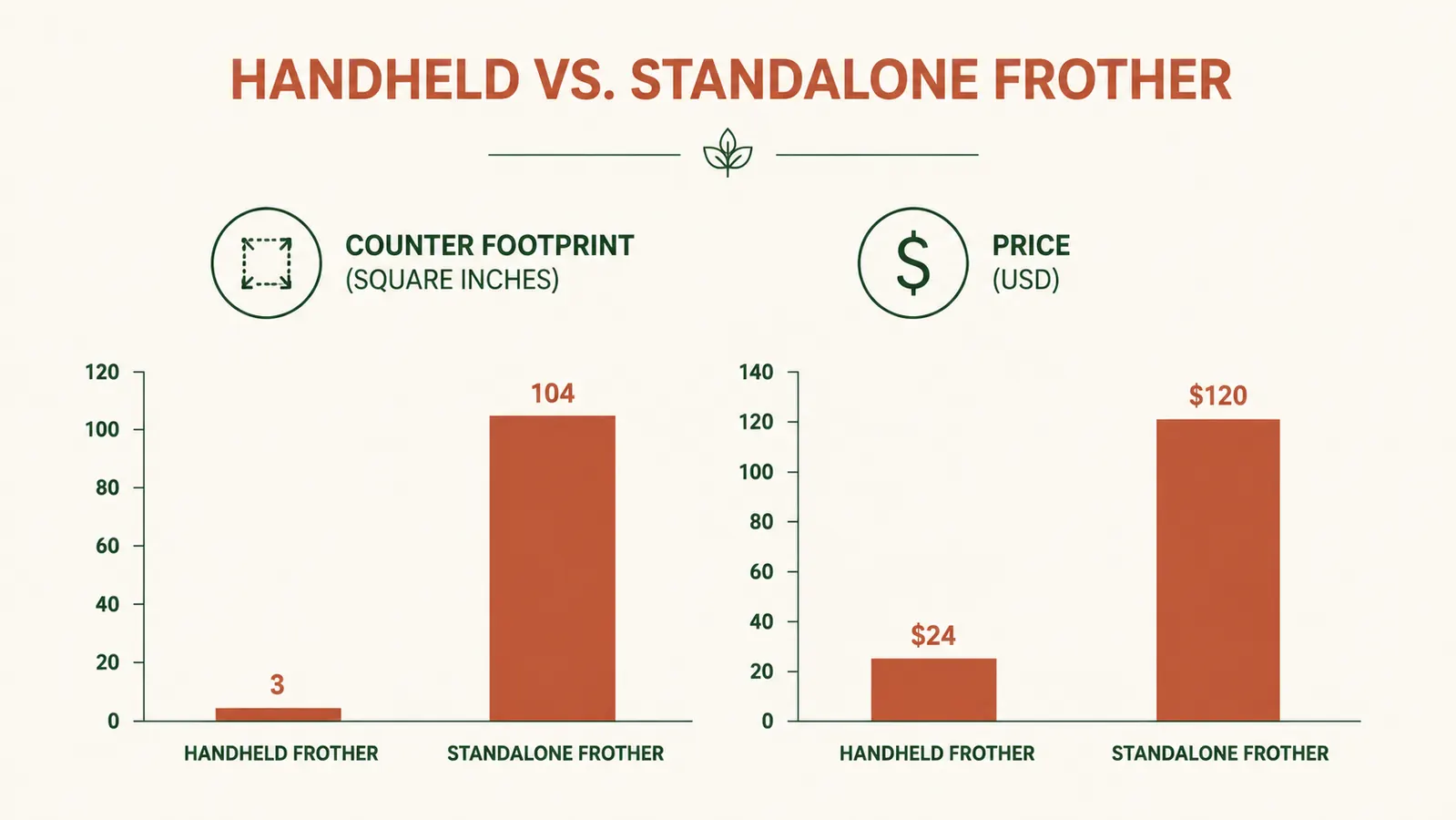
The Real Cost Over Time
Price on the sticker is one thing, but I think about cost differently now that I'm retired and watching a budget more carefully than I used to. The Zulay wand is under $10 at today's price and runs on batteries that last me a couple months of daily use. Even replacing batteries a few times a year, I'm still spending less in the first year than the standalone machine cost me upfront, and there's no motor or heating element that can eventually burn out on me either.
The standalone frother my daughter gave me runs $35 to $60 depending on the model, and while it doesn't need batteries, it does need an outlet and a spot near that outlet permanently. In a small kitchen, counter space has a cost too, even if nobody puts a price tag on it. Every appliance sitting out is one more thing I have to work around when I'm actually cooking, one more thing to dust, one more thing my two Yorkies can knock a cord loose from when they're underfoot chasing each other around the kitchen island.
I also think about what happens when something breaks. If the Zulay wand ever quits on me, I'm out less than $10 and I replace it without a second thought. If the motor in the standalone pitcher goes, I'm looking at replacing a $45 appliance, or hoping a warranty covers it. For a fixed retirement budget, that difference in downside risk matters more to me now than it used to.
What I Wish I'd Known Sooner
If I could go back, I'd have bought the handheld wand years before I finally did, instead of assuming a bigger machine automatically meant a better one. I think a lot of us default to the fuller-featured option because it feels like more value for the dollar, and sometimes that's true. But in a small kitchen, the feature that actually matters most is often just whether something gets used, and whether it gets in your way when it isn't.
I'd also tell myself not to feel guilty about it. The standalone machine wasn't a bad gift or a bad purchase, it just didn't match the kitchen I live in now. Kitchens change, and what worked in a house with a wraparound counter doesn't always work in an apartment galley kitchen. There's no shame in admitting the smaller, simpler tool is the better fit for where you are.
Who Should Buy Which
If you're cooking and living in a smaller kitchen, apartment, or a place where every appliance has to earn its spot, get the handheld frother. It's cheap enough that trying it isn't a real risk, and it solves the actual problem most solo coffee drinkers have, which is wanting foam without wanting a machine to manage. That's been true for me most mornings for the past six months, and I don't see that changing.
If you've got a dedicated coffee station, you're frothing for more than one person regularly, or you genuinely care about foam texture the way some people care about knife sets, the standalone route makes sense. Just know it's going to want a permanent spot on your counter, and in a small kitchen that's a bigger ask than the price tag suggests. My daughter's gift still comes out for holidays when the whole family's here. The rest of the year, it's the little wand doing the work, and honestly, I don't miss the shuffle at all.
Ready to stop clearing counter space for a foam machine?
The Zulay handheld frother stores in a drawer, runs on two AA batteries, and gets you real foam in under 30 seconds.
Amazon Check Today's Price on Amazon →